For today’s automotive technician, a multimeter is often just the starting point. When diagnosing complex intermittent faults, sensor signals, or communication network issues, you need to see the electrical story unfold in real time. That’s where an automotive oscilloscope becomes an indispensable tool in the shop. This roundup covers a range of scopes, from budget-friendly handheld units to professional multi-channel systems, to help you find the right instrument for your diagnostic needs and budget.
The Best Automotive Oscilloscopes for Professional Diagnostics
- HANMATEK Handheld Digital Oscilloscope 50Mhz Bandwidth
- Hantek 1008C PC USB 8CH Automotive Diagnostic Oscilloscope
- FNIRSI 1013D Plus Portable Handheld Tablet Oscilloscope
- AUKUYEE 2.4″TFT Handheld Digital Oscilloscope Kit
- Pico Technology PicoScope 2204A Oscilloscope 2 Channels
- Veepeak OBDCheck BLE Bluetooth OBD II Scanner
- Hantek CC650 AC/DC Current Clamp for Oscilloscopes
- PicoScope 4425A Automotive Oscilloscope Kit
- Autel MaxiScope MP408 4-Channel Automotive Oscilloscope
HANMATEK Handheld Digital Oscilloscope 50Mhz Bandwidth
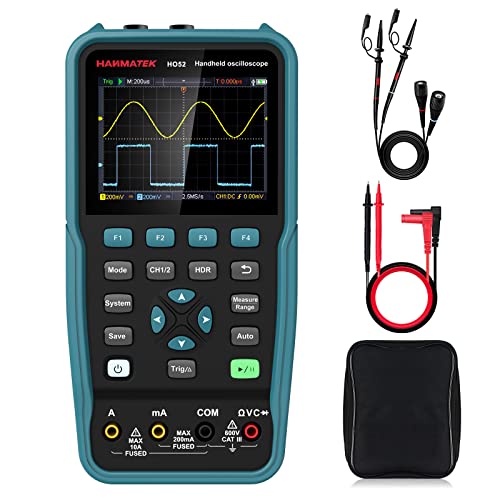
This HANMATEK unit is a versatile 2-in-1 tool that combines a 50MHz oscilloscope with a 4.5-digit multimeter, making it a compact all-in-one solution for field diagnostics. Its high waveform refresh rate and one-key auto-setting function help you capture intermittent glitches quickly and get stable readings with minimal setup. The portable design is enhanced by USB-C connectivity, allowing you to power it with a battery bank or transfer saved waveforms to a computer for further analysis.
The independent inputs for the scope and meter mean you can perform simultaneous measurements without swapping leads. Features like cursor measurement, seven automatic measurement functions, and a memory function for storing waveforms add to its practicality for automotive electrical work. For technicians who need a capable, self-contained instrument that doesn’t require a laptop, this is a strong contender.
Hantek 1008C PC USB 8CH Automotive Diagnostic Oscilloscope

The Hantek 1008C stands out by offering eight input channels at a very accessible price point, which is ideal for monitoring multiple sensors or actuators simultaneously. As a USB-based device, it uses your computer’s processing power and display, providing a large, clear screen for viewing complex waveforms. Its 12-bit resolution offers better vertical detail than many standard 8-bit scopes, which can be crucial for seeing small voltage changes in sensor signals.
This model functions not only as an oscilloscope but also as a data acquisition (DAQ) card and a programmable signal generator. This multi-functionality makes it a powerful bench tool for advanced diagnostics, component testing, and even simulating signals. For shops that need to monitor CAN bus lines, multiple ignition coils, or fuel injectors at the same time, the eight channels are a significant advantage.
FNIRSI 1013D Plus Portable Handheld Tablet Oscilloscope

With its 7-inch touchscreen and tablet-style design, the FNIRSI 1013D Plus offers a modern user experience with high portability. It provides a robust 100MHz bandwidth and a fast 1GSa/s sampling rate, specifications that allow it to accurately capture high-frequency noise and fast digital signals found in modern vehicles. The built-in high-voltage protection is a critical safety feature for automotive environments where voltage spikes are common.
The large internal battery supports hours of cordless use in the shop or on a road test, while the substantial 1GB storage space lets you save hundreds of screenshots and waveform files for later review or creating reports. The intuitive touch interface and bright display make waveform navigation and analysis straightforward, reducing the learning curve for technicians new to using scopes.
AUKUYEE 2.4″TFT Handheld Digital Oscilloscope Kit
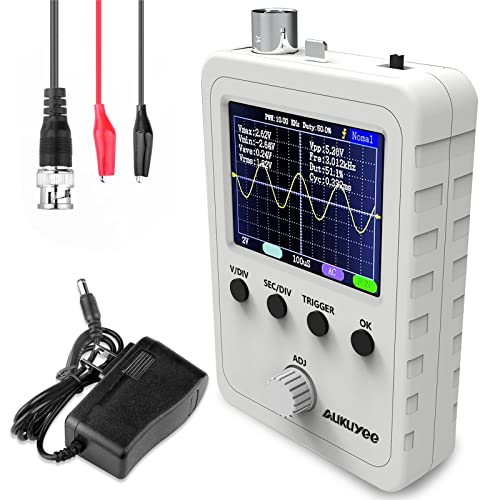
This AUKUYEE model is a compact and economical entry point into the world of oscilloscopes. Its updated version features an improved sensitivity range from 5mV/div to 20V/div, making it suitable for both low-level sensor signals and higher voltage system checks. The inclusion of a rotary encoder is a notable upgrade, as it allows for much quicker and more precise adjustment of settings compared to button-only interfaces.
Its design separates the analog and digital circuits onto different boards, which can help reduce internal noise and provide cleaner signal measurements. While the screen is small, its complete kit includes the necessary probes and power supply, making it ready to use right out of the box for basic automotive waveform observation and learning purposes.
Pico Technology PicoScope 2204A Oscilloscope

The PicoScope 2204A is a USB-powered scope known for its powerful and intuitive PC software, which greatly expands its capabilities beyond hardware specs. The software includes a deep array of automotive-specific tests, serial protocol decoders, and a sophisticated spectrum analyzer mode. This turns the two-channel hardware into a comprehensive diagnostic station that can graph sensor data, decode CAN messages, and analyze frequency-based signals.
With up to 12 bits of enhanced resolution, it reveals fine details in waveforms that lower-resolution scopes might miss. The included function and arbitrary waveform generator allow you to test components by injecting known good signals. For technicians who value deep software integration and advanced analysis features, the PicoScope ecosystem is a professional-grade choice.
Veepeak OBDCheck BLE Bluetooth OBD II Scanner

While not a traditional oscilloscope, this Veepeak OBD2 scanner is included as a vital complementary tool for any diagnostic toolkit. It provides access to live sensor data streams from the vehicle’s ECU, which can be graphed over time in supporting apps to observe trends and correlations. This data-logging capability is useful for diagnosing intermittent issues related to fuel trim, oxygen sensors, or misfires that occur under specific driving conditions.
Its broad compatibility with both iOS and Android devices via Bluetooth makes it a versatile and affordable way to add data monitoring to your process. Pairing this live data with physical waveform measurements from a scope can give you a complete picture of both the command and the actual electrical response in a system.
Hantek CC650 AC/DC Current Clamp

Current measurement is a fundamental part of automotive electrical diagnosis, and the Hantek CC650 is a dedicated accessory that enables any oscilloscope to measure current draw safely and accurately. It can measure both AC and DC current up to 650A, which covers everything from starter motor surges to small sensor circuits. Seeing current waveforms is essential for diagnosing issues with fuel pumps, cooling fans, ignition systems, and parasitic draws.
With a bandwidth of 400Hz and a sensitivity of 1mV/10mA, it provides a clear and proportional voltage output that your scope can read. This tool transforms your oscilloscope’s voltage-measuring capability into a powerful current-analysis tool, completing your electrical diagnostic arsenal.
PicoScope 4425A Automotive Oscilloscope Kit
The PicoScope 4425A represents the high end of dedicated automotive oscilloscope solutions. This four-channel kit is designed from the ground up for the professional technician, often coming bundled with a tailored suite of accessories like test leads, breakout cables, and current clamps. Its high sampling rate and long capture memory are built to handle the complex, intermittent signals found in modern vehicle networks.
The accompanying software is arguably its greatest strength, featuring pre-configured tests for specific components like injectors, ignition coils, and relative compression. These guided tests simplify complex procedures and help standardize diagnostics across a shop. For busy professional environments where accuracy, speed, and comprehensive reporting are required, this type of integrated kit is a top-tier investment.
Autel MaxiScope MP408 4-Channel Automotive Oscilloscope
Autel’s MaxiScope MP408 is a robust, standalone handheld oscilloscope built for the demands of the shop floor. Its four isolated input channels allow for safe and simultaneous measurement of different circuits, which is critical for comparing timing between sensors and actuators. The rugged design and bright display are made to be readable in various lighting conditions, from a dark shop corner to under the hood.
As part of the Autel tool ecosystem, it may offer integration with other Autel diagnostic devices, providing a streamlined workflow. With dedicated automotive functions and a interface designed for technicians, it aims to deliver professional-grade oscilloscope capabilities in a familiar, portable format that doesn’t rely on an external computer.
How to Choose the Best Automotive Oscilloscope for Technicians
Let’s be honest, picking the right automotive oscilloscope can feel like trying to diagnose a complex CAN bus fault without a wiring diagram. I’ve tested a bunch, and the “best” one completely depends on your shop’s needs and your budget. The first thing I look at is bandwidth and sample rate. For most modern vehicle diagnostics, you’ll want a minimum of 50 MHz bandwidth. This lets you accurately see signals from simple sensors all the way up to faster communication lines. Sample rate is equally crucial; think of it as the detail in a picture. A higher sample rate captures fast transients and glitches that a slower scope might completely miss.
Next up, channel count. A two-channel scope is the absolute baseline and will handle probably 70% of your tasks, like comparing cam and crank signals. But if you’re serious about drivability or chasing intermittent faults, four channels is a game-changer. Being able to monitor fuel injector, ignition coil, sensor reference, and ground simultaneously saves hours. I also always check the input voltage range. Automotive scopes need to handle the high-voltage spikes from ignition systems (often up to 500V or more) without blowing up. Make sure yours has dedicated high-voltage attenuation settings.
The user interface is where many scopes live or die. A tiny, dim screen in a bright shop is useless. I prefer a large, bright display with responsive touch controls. The software should have pre-configured tests for common components—like oxygen sensors, MAF, or ignition secondary—so you’re not manually setting up every single time. This feature alone can cut your diagnostic time in half. Also, consider connectivity. Does it save waveforms easily? Can it connect to a PC for bigger screen analysis or generate professional reports for customers? These workflow features matter more than you think.
Finally, think about the form factor. A bulky benchtop scope is powerful but anchors you to one spot. A handheld or tablet-based model offers incredible mobility around the vehicle and the shop. Durability is key here; it will get dropped, covered in grease, and live in a toolbox. Look for a robust build. Remember, the goal of using one of the best automotive oscilloscopes for technicians is to get from problem to solution faster and with more certainty. Don’t just buy for specs on paper; buy for how it will fit into your daily diagnostic routine.
Frequently Asked Questions
Can I use a general electronics oscilloscope for automotive work?
You can, but I don’t recommend it as your primary tool. General lab scopes often lack the high-voltage protection needed for ignition systems and usually don’t have the automotive-specific software and pre-set tests. You’ll spend a lot of time figuring out settings and building probe setups that a dedicated automotive scope provides instantly. It’s like using a wrench as a hammer—it might work, but it’s not the right tool.
How many channels do I really need?
For students or hobbyists, two channels can get you started. But for a professional technician, I strongly advise getting a four-channel model. Modern diagnostics often require looking at multiple related signals at once. For example, to properly analyze a misfire, you might want to view the ignition coil control signal, the primary current, the secondary ignition pattern, and the injector pulse all together. With two channels, you’re taking multiple captures and hoping the fault repeats, which wastes time.
What’s more important, bandwidth or sample rate?
They work as a team, but if I had to prioritize for automotive use, I’d lean slightly toward a higher sample rate. Bandwidth determines the fastest signal you can measure accurately. Sample rate determines how much detail you see within that signal. A very fast sample rate will capture those tiny, intermittent glitches in a sensor output or communication line that cause no-code drivability issues. A good rule of thumb is a sample rate at least 5 to 10 times the bandwidth.
Are the wireless or Bluetooth scopes any good?
The wireless models I’ve tested are fantastic for mobility, allowing you to place the scope in the engine bay and view the waveforms on a tablet from the driver’s seat. This is invaluable for road testing. However, be cautious of potential signal latency or dropout. Wired connections are always more reliable for a critical capture. Many pros have a main wired unit and a smaller wireless one for specific tasks.
How do I justify the cost to my shop or for myself?
Frame it as an investment that pays for itself by solving jobs that would otherwise be “swap and pray” or require an outside specialist. A good scope turns guessing into knowing. It allows you to confidently diagnose complex faults, quote repairs accurately, and provide proof to the customer. One or two difficult diagnoses that you nail because of the scope can cover its cost. When evaluating the best automotive oscilloscopes for technicians, consider its cost per use over five years—it becomes a very small number compared to the revenue it generates.