When a dashboard warning light illuminates, real-time data is your most powerful tool. A capable live data OBD2 scanner goes beyond simple code reading, allowing you to monitor sensor readings, system voltages, and performance parameters as they happen. This immediate feedback is crucial for diagnosing intermittent issues, verifying repairs, and understanding your vehicle’s true health.
From professional-grade bidirectional tablets to simple Bluetooth adapters, the right scanner depends on your needs and expertise. This roundup tests nine of the best options for real-time analysis, helping you find the perfect balance of power, functionality, and value to keep your diagnostics precise and informed.
The Best Live Data OBD2 Scanners for Your Garage
- Autel Scanner MaxiCOM MK808S
- LAUNCH OBD2 Scanner CRP123I V3.0 Elite
- Veepeak Mini Bluetooth OBD2 Scanner for Android
- Launch Creader 200 OBD2 Scanner 2025
- Thinkdiag OBD2 Scanner Bluetooth Full System
- AUTOPHIX 3210 OBD2 Scanner Bluetooth
- MOTOPOWER MP69033 Pro OBD2 Scanner
- MUCAR CS6 OBD2 Scanner Diagnostic Tool
- OBD2 Scanner Reader Bluetooth Wireless
Autel Scanner MaxiCOM MK808S

For professional technicians and serious enthusiasts, the Autel MK808S represents a top-tier diagnostic solution. Its bidirectional control allows you to command vehicle components during an active test, making it possible to verify the operation of actuators like windows, mirrors, and fuel pumps in real time. This feature, combined with all-system diagnostics, provides a factory-level look into every module of the vehicle.
The scanner displays comprehensive live data in a 5-in-1 format for detailed analysis and supports over 28 essential service functions like injector coding and battery registration. With Wi-Fi printing for reports and coverage for 150+ brands, it is a powerful, standalone tool that doesn’t require a separate phone or tablet to operate.
LAUNCH OBD2 Scanner CRP123I V3.0 Elite
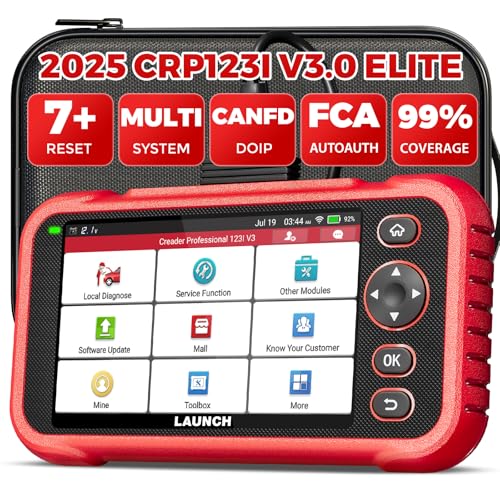
The LAUNCH CRP123I V3.0 is a robust, all-in-one tablet scanner built for speed and efficiency. Its 2025 upgrade includes a faster processor and new protocol support (CANFD & DoIP), ensuring compatibility with the latest vehicles. The tool offers lifetime free updates, which is a significant value, and its 4-in-1 graphing of live data helps visualize sensor trends for accurate diagnosis.
Beyond full system scans, it adds seven key reset functions and a dedicated battery voltage test with graphing. The ability to store, playback, and share vehicle health reports via email makes it an excellent choice for small shops or advanced DIYers who need professional functions without the highest professional price.
Veepeak Mini Bluetooth OBD2 Scanner for Android

This compact adapter is a perfect entry point for Android users seeking basic live data and code reading. It wirelessly connects to a wide range of third-party diagnostic apps, allowing you to choose the software that best fits your needs. You can monitor essential live sensor data such as RPM, vehicle speed, coolant temperature, and fuel trim directly on your phone or tablet.
The Veepeak Mini is ideal for tracking fuel economy, checking readiness monitors for smog tests, and understanding the cause of a check engine light. Its simplicity and low cost make it a great first scanner, though it’s important to note it is not compatible with iOS devices.
Launch Creader 200 OBD2 Scanner 2025

The Launch Creader 200 is a straightforward, handheld unit that provides reliable four-system diagnostics for engine, transmission, ABS, and SRS. It performs full OBD2 functions and features a helpful data stream playback function, letting you record and review live data to pinpoint intermittent problems.
With automatic VIN identification and one-click vehicle health reports, it simplifies the diagnostic process. This scanner is a solid middle-ground option for those who want more capability than a basic code reader but prefer a dedicated device over a Bluetooth adapter that relies on a smartphone.
Thinkdiag OBD2 Scanner Bluetooth Full System

Thinkdiag leverages the power of your smartphone or tablet to deliver professional, full-system diagnostics with bidirectional capabilities. It supports an impressive array of over 15 advanced reset and calibration services, including SAS, TPMS, and transmission adaptation, which are often found on much more expensive tools.
The app provides access to live data, module coding, and even potential feature activation for certain brands. This model is an excellent value for its feature set, offering near-professional level functionality through a convenient Bluetooth connection and a familiar mobile interface.
AUTOPHIX 3210 OBD2 Scanner Bluetooth

The AUTOPHIX 3210 is a versatile Bluetooth scanner compatible with both iOS and Android, requiring no subscription fees. It excels at providing clear, real-time data and performance metrics, including trip monitoring with details on hard braking, idle time, and average speed.
Its companion app helps interpret check engine codes and can even search for fixes online. For the DIYer interested in monitoring driving habits and vehicle performance over time, this tool offers a compelling mix of diagnostic and analytical features.
MOTOPOWER MP69033 Pro OBD2 Scanner

This standalone scanner is a “plug and play” device that requires no apps, Wi-Fi, or external batteries. It combines essential OBD2 code reading and live data graphing with a built-in battery and alternator tester, providing a convenient all-in-one diagnostic check.
You can view real-time data streams and curves for parameters like engine speed and coolant temperature directly on its screen. The MOTOPOWER MP69033 is ideal for users who want a simple, self-contained tool for basic diagnostics and electrical system verification without any smartphone dependency.
MUCAR CS6 OBD2 Scanner Diagnostic Tool

The MUCAR CS6 is a capable handheld unit that diagnoses six major systems, including BCM and TPMS. It comes with seven of the most frequently used reset services, such as oil reset, EPB, and DPF regeneration, which are valuable for routine maintenance.
It offers lifetime free updates and provides not just code definitions but also possible causes and reported fixes for specific vehicle codes. This scanner is a practical choice for home mechanics and small garages looking for a dedicated tool with useful service functions at an accessible level.
OBD2 Scanner Reader Bluetooth Wireless

This Bluetooth 5.4 adapter, the V011, is designed for universal compatibility with iOS and Android. It focuses on providing a comprehensive diagnostic experience through its exclusive app, featuring strong data visualization with clear charts for live parameters like engine speed and temperature.
The app includes performance testing and helpful guides to interpret codes and suggest fixes. It is a user-friendly option for car owners who want to understand their vehicle’s condition, monitor real-time data, and handle basic diagnostics with guidance built into the application.
How to Choose a Live Data OBD2 Scanner
Picking the right tool for real-time analysis can be tricky with so many options. I’ve tested a bunch, and the key is to match the scanner’s features to what you actually need. Don’t just grab the cheapest one or the most expensive; think about what you’ll use it for. Are you a DIYer trying to fix a rough idle, or a more advanced user tuning a performance engine? Your answer changes everything.
First, check compatibility. Almost all scanners work with OBD2 cars (1996 and newer in the US), but you need to be sure it connects to your specific vehicle’s computer. I always look for ones that say they cover all 10 OBD2 protocols. For real-time data, the connection method matters a lot. A basic Bluetooth dongle paired with a phone app is great for casual use and viewing data streams. For faster, more reliable data logging—especially if you’re watching things like fuel trim or ignition timing—a direct wired connection (USB or proprietary cable) to a laptop or dedicated handheld unit is the way to go. The wireless ones are convenient, but they can sometimes lag or drop out.
Next, focus on the software and display. The best live data OBD2 scanners present information clearly. Can you customize the dashboard to show the four or five parameters you care about most in big, easy-to-read numbers? Can you graph two sensors together, like oxygen sensor voltage against fuel trim, to see how they interact? This graphing feature is a game-changer for diagnosis. Also, consider update frequency. A slow scanner that updates once per second is almost useless for real-time work; you want one that refreshes multiple times a second to catch quick glitches.
Finally, think about extra functions. Basic code reading and clearing is a given. But do you need bi-directional controls to test actuators? How about advanced functions like ABS or airbag system scanning? These special features usually cost more. For most home mechanics, a robust scanner that excels at fast, clear live data and graphing is the sweet spot. It lets you see the story your engine is telling, not just read its fault codes.
FAQ
What exactly is “live data” from an OBD2 scanner?
Live data, also called data streaming or PID data, is the real-time information being broadcast by your car’s various sensors and computer modules. While a code tells you a problem happened, live data shows you what’s happening right now. Think of it like a doctor checking your vital signs—heart rate, blood pressure—instead of just reading a note about a past symptom. I use it to watch sensor values like engine coolant temperature, oxygen sensor activity, fuel trims, and short/long term fuel trim while the engine is running to pinpoint issues.
Can I use a cheap Bluetooth OBD2 dongle for real-time analysis?
You can, and I’ve tested many of them. They are fantastic for basic monitoring and casual use. The big caveat is data speed and reliability. Cheap dongles often have a slow refresh rate and can buffer, meaning the data you see is delayed. For serious diagnosis, like tracking down a misfire or a sticky sensor, this lag can make you miss the clue. They work, but for dedicated, reliable real-time analysis, a mid-range wired scanner or a higher-end wireless model designed for speed is usually better.
Why is graphing so important for live data?
Numbers on a screen are hard to interpret when they’re changing rapidly. A graph paints a picture. It lets you see trends, patterns, and relationships between two or more parameters over time. For example, seeing a squiggly line for your upstream O2 sensor is normal; a flat line means it’s dead. You can graph throttle position against MAF sensor readings to see if they correlate. It turns abstract numbers into a visual story, making diagnosis much more intuitive.
Do I need a special scanner for European or Asian cars?
Not necessarily for basic OBD2 live data. All cars sold in the US since 1996 must support standard OBD2 parameters. However, many European and Asian manufacturers use additional, manufacturer-specific parameters. To access the full depth of live data on these cars—like specific BMW or Toyota sensor readings—you may need a scanner that advertises enhanced manufacturer coverage for your specific brand. A standard scanner will give you the universal data, but might not show everything.
What’s the difference between 10Hz and 50Hz update rate?
This refers to how many times per second the scanner refreshes the data from your car’s computer. 10Hz means 10 updates per second, 50Hz means 50 updates. A higher rate (Hz) gives you a much smoother, more immediate view of what’s happening. For watching something like ignition timing advance under acceleration, a higher update rate is critical. A slow rate might make you miss a sudden knock event. When looking for the best live data OBD2 scanners for real-time analysis, the update rate is a key spec to check.