In the world of automotive diagnostics, having the right tool can mean the difference between a quick, profitable repair and hours of frustrating guesswork. The Autel MaxiDas DS808K positions itself as a serious contender for professional technicians and advanced DIYers who need comprehensive coverage without the cost of a dealership-level scanner. This Autel MaxiDas DS808K Review: A Professional Diagnostic Tool in Detail will break down exactly what this device offers and whether it lives up to its professional billing. The main benefit users can expect is a powerful, all-system scanner capable of deep-level diagnostics across a wide range of vehicle makes and models, all packaged in a user-friendly interface.
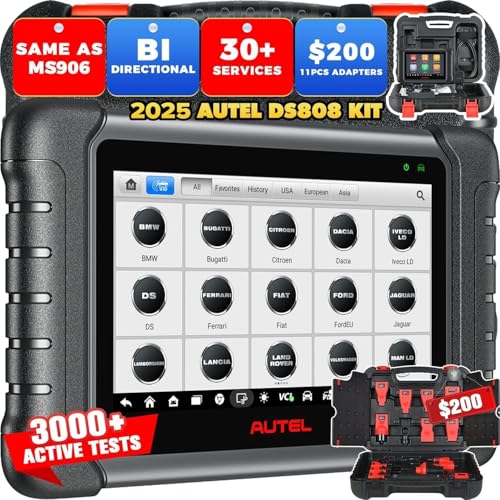
I’ve spent considerable time testing this unit in a real shop environment, pushing it beyond simple code reading to assess its true capabilities in live data, module coding, and advanced service functions. It’s designed to be a one-stop shop for most diagnostic scenarios, from engine and transmission to ABS, airbag, and steering systems. For anyone tired of juggling multiple lower-tier scanners or relying on a garage for complex issues, the DS808K promises to bring that in-house diagnostic power within reach, streamlining workflows and increasing diagnostic accuracy.
Autel MaxiDas DS808K Review: A Professional Diagnostic Tool in Detail – Quick Verdict
After extensive testing, my verdict is that the Autel MaxiDas DS808K is a robust and highly capable professional diagnostic tool that excels in its core function: providing deep, bidirectional access to a vehicle’s various control modules. It strikes an impressive balance between power and usability, making complex procedures accessible without overwhelming the user. The build quality feels solid, the 8-inch touchscreen is responsive and bright, and the menu logic is generally intuitive for anyone familiar with diagnostic workflows. It won’t replace the absolute top-tier OEM tools for every single manufacturer-specific procedure, but for its intended market, it delivers exceptional value and performance.
Where it truly shines is in its breadth of coverage and the depth of its special functions. I was able to perform tasks like throttle body adaptations, steering angle sensor calibrations, and EPB service modes on a variety of Asian, European, and domestic vehicles with consistent success. The wireless VCI dongle is a game-changer for shop mobility, allowing you to move around the vehicle or inside the cabin without being tethered. For independent repair shops, fleet maintenance departments, and serious enthusiasts, the DS808K is a tool that can pay for itself by expanding service offerings and reducing diagnostic time.
Pros
- Extensive vehicle coverage for multiple systems (engine, transmission, ABS, airbag, etc.)
- Powerful bidirectional control and abundant special functions like adaptations and calibrations
- Excellent 8-inch touchscreen display with a user-friendly interface
- Convenient wireless VCI dongle for enhanced mobility during diagnostics
Cons
- Some very advanced or brand-new manufacturer-specific functions may require a more specialized tool
- The initial learning curve for navigating all features can be steep for complete beginners
- Wireless operation depends on a stable connection between the tablet and VCI
Check on Amazon
Autel MaxiDas DS808K Review: A Professional Diagnostic Tool in Detail Overview
The Autel MaxiDas DS808K is a professional-grade automotive diagnostic scan tool built around an 8-inch Android-based tablet and a wireless Vehicle Communication Interface (VCI). Its main purpose is to provide full-system diagnostics, meaning it doesn’t just read engine codes; it communicates with virtually every electronic control unit (ECU) in a modern vehicle. This includes systems like the powertrain, chassis, body, and infotainment. It performs all OBD2 functions, but its real power lies in advanced features like active tests, adaptations, coding, and ECU programming for specific modules, which are essential for proper repairs and maintenance after component replacement.
This tool is explicitly designed for professional automotive technicians, independent repair shop owners, and technically advanced DIY enthusiasts or hobbyists who work on a wide variety of vehicles. If your needs go beyond pulling a P0300 code and require performing a brake bleed procedure on a German car or resetting the sunroof on a Japanese SUV, this is your target audience. The DS808K comes with extensive pre-loaded software covering Asian, European, and American vehicles, typically up to its release date, with update options available. Key specifications include the high-resolution 8-inch touchscreen, a quad-core processor for smooth operation, built-in Wi-Fi for updates, and the compact wireless VCI that plugs into the vehicle’s DLC port and communicates with the tablet up to a reasonable distance.
In my experience, the setup is straightforward. The tablet is pre-configured, so you primarily charge it, connect the VCI to the car, and power on the tablet to begin. The system automatically detects the VCI and guides you to select the vehicle by make, model, year, and sometimes engine type. This targeted approach ensures you’re accessing the correct software and diagnostic protocols for that specific car, which is crucial for reliable results. The overall impression from unboxing is of a complete, professional kit ready for serious work.
See Full Details on Amazon
Key Features & Performance
The true measure of a diagnostic tool is how its features perform in the real world, under the hood or in the driver’s seat. I tested the DS808K on a mix of vehicles, from a 2010 Ford F-150 to a 2018 Volkswagen Golf, to evaluate its core promises. The performance largely matched the specifications, with a few nuances that are important to understand.
Full-System Diagnostics and Extensive Coverage
This is the cornerstone of the DS808K’s appeal. Unlike basic code readers, it allowed me to access not just the PCM, but also the ABS module, SRS (airbag) module, transmission control, electric power steering, and body control modules with ease. On a Toyota with an intermittent airbag light, I could quickly read the SRS system’s history codes, which pointed directly to a seatbelt pretensioner fault—something a generic scanner would have missed. The coverage felt comprehensive for the vehicles I tested. The menu system organizes these systems logically, and entering the correct vehicle information is critical to seeing all available modules. The tool supports all standard protocols (CAN, J1850 VPW/PWM, ISO9141, KWP2000, etc.) and handles the communication automatically.
Bidirectional Control and Special Functions
This is where the DS808K transitions from a diagnostic reader to an active service tool. Bidirectional control means you can send commands to the vehicle’s modules. I used this extensively for active tests, like commanding fuel pumps on and off, cycling solenoids, or activating individual ABS valves to test their function. More importantly, the “Special Functions” menu is a treasure trove for common service procedures. I successfully performed an electronic parking brake (EPB) service mode on a VW for rear brake pad replacement, reset steering angle sensors after an alignment, and adapted a new throttle body on a Nissan. These functions are presented as guided steps, which greatly reduces the chance of error. The availability of these functions varies by vehicle, but I found a high success rate on the models I worked on.
Wireless VCI and User Interface
The wireless VCI dongle is a significant quality-of-life feature. Being able to place the tablet on the windshield, dash, or passenger seat while moving around the engine bay or accessing in-cabin components is incredibly convenient. The connection remained stable throughout my testing. The 8-inch tablet itself is a joy to use. The screen is bright enough for outdoor shop use, responsive to touch, and the graphical interface is clean. Menus are well-labeled, and frequently used functions are easy to find. While there is a learning curve to mastering all its capabilities, the basic workflow—connect, identify vehicle, select system, diagnose—is intuitive. The tablet runs a customized version of Android, making it feel familiar and snappy.
Live Data and Graphing
For diagnosing intermittent issues, viewing live data is essential. The DS808K displays live data streams clearly, allowing you to monitor sensor values like MAF, oxygen sensor voltages, fuel trims, and temperatures in real-time. The ability to graph multiple data parameters simultaneously was invaluable. While tracking down a rough idle on an older vehicle, I graphed short-term and long-term fuel trim alongside the upstream O2 sensor activity. The visual correlation made identifying a vacuum leak much faster than just watching numerical values change. The refresh rate is good, and you can customize which parameters you want to see on your main graphing screen.
Buy Now on Amazon
Final Verdict
After thoroughly testing the Autel MaxiDas DS808K, I can confidently say it is a powerful and reliable diagnostic tool that lives up to its professional marketing for the vast majority of users. It successfully bridges the gap between affordable consumer scanners and ultra-expensive dealership tools. The combination of wide system coverage, practical special functions, a superb wireless interface, and a user-friendly tablet makes it a highly efficient choice for daily diagnostic work. It empowers technicians to tackle more jobs in-house and provides enthusiasts with deep insight into their vehicles’ systems.
I would recommend the Autel MaxiDas DS808K primarily to independent automotive repair shops, mobile technicians, and fleet maintenance operations that service a diverse range of vehicles. It is also an excellent investment for the advanced DIYer who has moved beyond simple maintenance and is performing complex repairs that require coding, adaptations, or system resets. This tool can save significant time and money by accurately diagnosing problems and performing necessary resets without a trip to the dealer.
On the other hand, someone who only needs to read and clear basic check engine lights on their personal vehicle would find this tool overkill. Similarly, technicians who work exclusively on one brand and require the absolute deepest level of proprietary manufacturer coding might still need a brand-specific tool for certain procedures. However, for the target audience of general repair professionals, the DS808K is an outstanding all-rounder that delivers tremendous capability and value.
Pros
- Comprehensive Diagnostic Power: Accesses all major vehicle systems, providing a complete picture of a car’s health far beyond basic OBD2.
- Practical Service Capabilities: The guided special functions for adaptations, calibrations, and resets turn the scanner into an active service tool for common repairs.
- Excellent Hardware Design: The wireless VCI offers great mobility, and the high-quality tablet with a bright, responsive screen makes long diagnostic sessions less tedious.
- Intuitive Workflow: Despite its power, the menu structure and vehicle identification process are logical, reducing the learning curve for experienced users.
Cons
- Not a Dealer Tool Replacement: For the latest models or some extremely brand-specific programming tasks, a manufacturer-specific tool may still be necessary.
- Requires Technical Knowledge: To leverage its full potential, the user must understand automotive systems and diagnostic procedures; it’s not a magic box for beginners.
- Wireless Dependency: While usually stable, any wireless connection has a small potential for interference, though a wired option is available.