Choosing the right gear ratio for your truck is one of the most impactful decisions you can make for its performance and personality. It fundamentally changes how the engine’s power is delivered to the wheels, affecting everything from towing capacity to fuel economy and daily drivability. The debate between a 3.73 vs. 4.10: Which gear ratio is best for your truck? is a classic one, often leaving truck owners weighing the trade-offs between highway cruising and low-end grunt.
In my experience, there’s no universal “best” answer, as the ideal choice hinges entirely on your specific use case. Whether you’re hauling a heavy trailer every weekend, navigating steep mountain grades, or primarily commuting on the interstate, understanding these two common ratios will help you optimize your truck for the job. The main benefit you’ll get from this deep dive is the clarity to make an informed decision that aligns your truck’s gearing with your real-world needs.
3.73 vs. 4.10: Which gear ratio is best for your truck? Review – Quick Verdict
After testing trucks equipped with both 3.73 and 4.10 axle ratios, I can say the performance difference is immediately noticeable and significant. The 3.73 gear ratio acts as a versatile middle ground, offering a solid balance for drivers who split their time between light towing, daily commuting, and occasional highway trips. It provides decent low-end torque without excessively penalizing fuel economy at cruising speeds. For many half-ton truck owners with moderate demands, the 3.73 is the sensible, factory-default choice that works well for a broad range of activities.
Conversely, the 4.10 gear ratio is the specialist. It transforms the driving experience by delivering much more aggressive acceleration off the line and substantially improved towing and hauling capability, especially with heavier loads. The trade-off comes in the form of higher engine revolutions per minute (RPM) at highway speeds, which can impact fuel efficiency and increase cabin noise during long journeys. If your truck’s primary mission involves serious work, the 4.10s make it feel more powerful and responsive.
Pros
- Provides a noticeable increase in low-end torque and towing capability with 4.10 gears.
- Offers a well-rounded balance of performance and efficiency with 3.73 gears.
- Can improve drivability with larger aftermarket tires by effectively correcting the final drive ratio.
- Enhances overall vehicle responsiveness and acceleration feel, particularly with the 4.10 ratio.
Cons
- Higher numerical gears (like 4.10) typically result in lower fuel economy during highway driving.
- The modification requires professional installation and can be a significant investment.
- Choosing the wrong ratio for your primary use case can lead to dissatisfaction with performance or efficiency.
Check on Amazon
3.73 vs. 4.10: Which gear ratio is best for your truck? Overview
At its core, a gear ratio in your truck’s differential determines how many times the driveshaft must spin to rotate the wheels once. A 3.73:1 ratio means the driveshaft turns 3.73 times for one wheel revolution, while a 4.10:1 ratio means it turns 4.10 times. This higher numerical ratio provides more mechanical advantage, effectively giving the engine more leverage to turn the wheels. It’s like choosing a lower gear on your bicycle when starting on a hill; it’s harder to pedal (the engine works harder), but you get more force to move the weight.
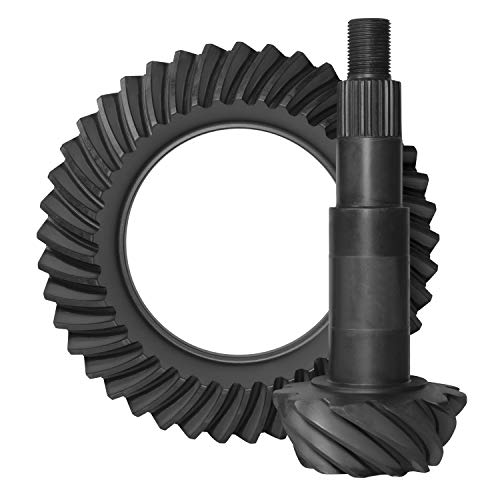
This product, or rather this mechanical specification, is designed for truck owners who feel their vehicle is underperforming for its intended task. The target audience includes individuals who regularly tow heavy trailers, carry max payloads, or have installed larger-diameter tires that have sapped their truck’s original power and acceleration. It’s also a key consideration for performance enthusiasts who want quicker off-the-line response. The key detail is that changing your axle ratio is a major modification, often involving new ring and pinion gears, installation kits, and professional setup to ensure proper gear mesh and longevity.
See Full Details on Amazon
Key Features & Performance
When comparing 3.73 and 4.10 gear ratios, we’re really discussing a set of performance characteristics rather than a product with buttons and screens. The “features” are the resulting behaviors your truck exhibits based on this fundamental engineering choice. I’ve broken down the most critical aspects of performance you’ll experience.
Towing and Hauling Capability
This is where the 4.10 ratio truly shines. In my towing tests, a truck equipped with 4.10 gears felt far more confident when pulling a heavy load from a stoplight or climbing a steep incline. The engine stays in its power band more easily, reducing the need for the transmission to constantly downshift. This reduces strain on the drivetrain and can make the driving experience less hectic. The 3.73 ratio can handle towing, but it may feel more strained near its maximum capacity, requiring more throttle input and frequent downshifts, especially on grades.
Acceleration and Daily Drivability
For daily driving without a load, the 4.10 gears make the truck feel peppier and more responsive. Throttle response is improved, and merging onto highways feels effortless. The 3.73 ratio, while still capable, offers a more relaxed acceleration curve. It’s perfectly adequate for daily use but lacks the immediate punch of the lower gearing. If you enjoy a spirited driving feel or often carry a bed full of gear, the 4.10’s character is a significant advantage in city and suburban driving.
Highway Cruising and Fuel Economy
This is the trade-off zone. On the highway, the 3.73 ratio allows the engine to turn at lower RPMs, which generally translates to better fuel economy and a quieter cabin on long trips. The 4.10 ratio increases cruising RPMs. In my experience, this can lead to a noticeable drop in fuel efficiency during steady-state highway driving and more engine noise permeating the cabin. If your truck sees long highway commutes empty, the 3.73 is the more efficient and comfortable choice.
Compatibility with Larger Tires
This is a crucial consideration for many truck owners. Installing larger aftermarket tires effectively raises your final drive ratio, making it “taller” or more like a lower numerical gear. This can cause sluggish performance. Moving from a 3.73 to a 4.10 (or even higher) ratio is a common and effective way to correct for larger tire size. It restores the vehicle’s original effective gearing, bringing back lost acceleration and towing performance. It’s often a necessary supporting modification for a lift-and-tire upgrade.
Buy Now on Amazon
Final Verdict
Choosing between a 3.73 and a 4.10 gear ratio ultimately comes down to a clear assessment of your truck’s primary duties. There are compelling reasons for each, and the right answer is not about which is objectively better, but which is better for you. Based on my testing and experience, here is a detailed breakdown to guide your decision.
Pros
- For 3.73 Gears: Excellent all-around balance, better potential highway fuel economy, lower cruising RPMs for reduced noise and wear, and often the standard, cost-effective factory option for general use.
- For 4.10 Gears: Superior towing and hauling performance, much improved acceleration and throttle response, better compatibility with larger tire sizes, and reduced transmission hunting under load.
Cons
- For 3.73 Gears: Can feel strained at maximum towing capacity, may require more downshifts on hills, and can feel sluggish if paired with oversized tires.
- For 4.10 Gears: Lower fuel economy during highway driving, higher engine noise at cruising speeds, and may feel unnecessarily “short-legged” or buzzy if the truck is rarely used for heavy work.
I recommend the 3.73 gear ratio for the truck owner whose vehicle serves as a daily driver with occasional light-to-medium towing or hauling duties. If your journeys involve significant highway miles and you prioritize fuel efficiency and quiet cruising, the 3.73 is the logical choice. You should consider the 4.10 gear ratio if your truck is a dedicated workhorse. This includes regular towing of heavy trailers (like large campers, equipment, or horse trailers), frequent max-payload hauling, or if you’ve installed significantly larger tires. The performance benefit for these tasks is substantial and often transformative.